
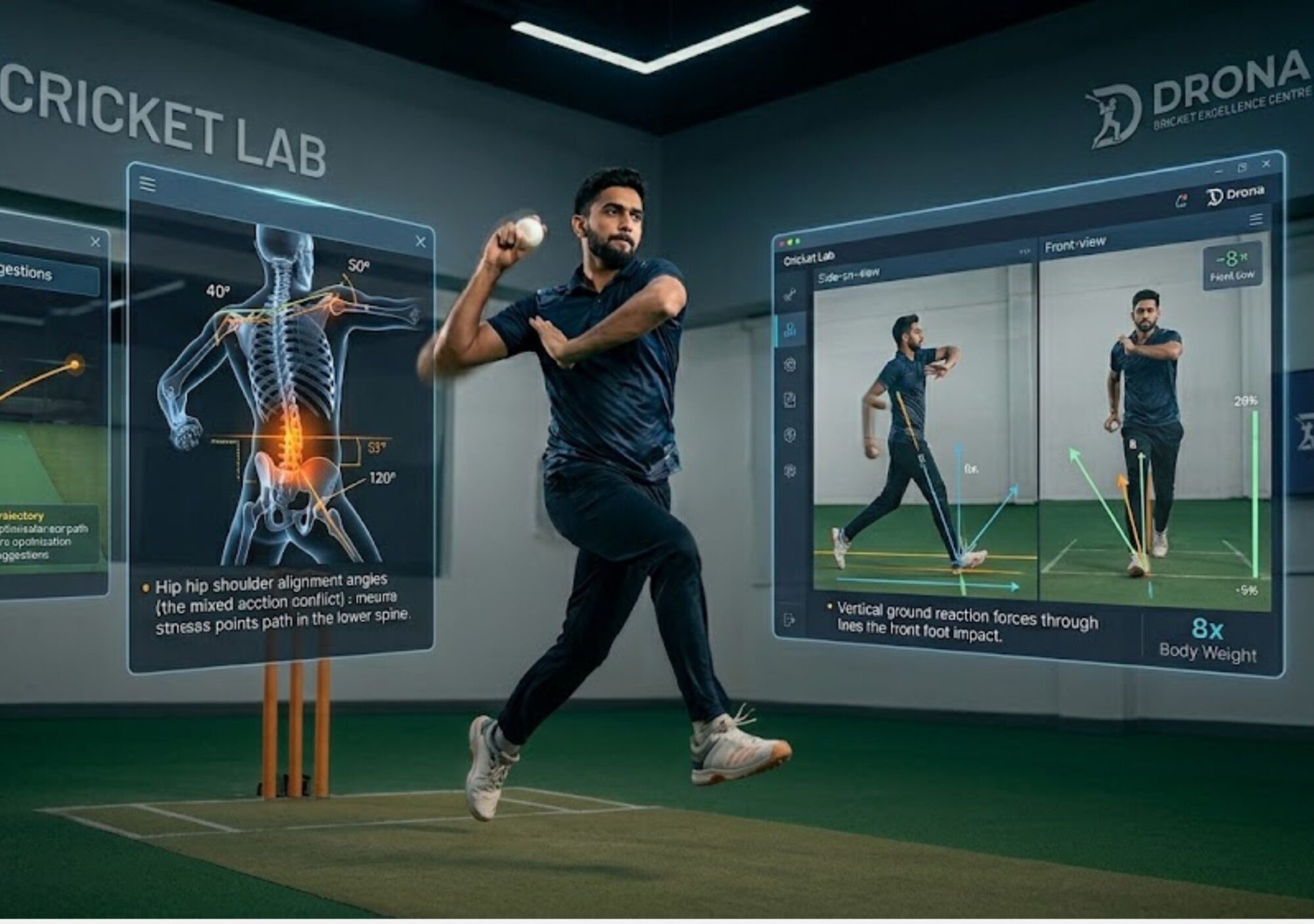
Fast bowling is arguably the most unnatural and violently explosive physical action in professional sports. Generating extreme pace is fundamentally an exercise in kinetic energy transfer, building momentum through the run-up and violently snapping that energy through the torso, shoulder, and fingers in a fraction of a second. However, the human body was not evolutionarily designed to absorb the immense forces generated during the delivery stride. When a fast bowler lands their front foot at the crease, the vertical ground reaction force surging upward through their skeletal structure can equal up to eight times their own body weight. If the biomechanics of their action are even slightly misaligned, this massive kinetic load does not transfer into the cricket ball; instead, it dissipates directly into their joints, ligaments, and bones, inevitably leading to devastating injuries.
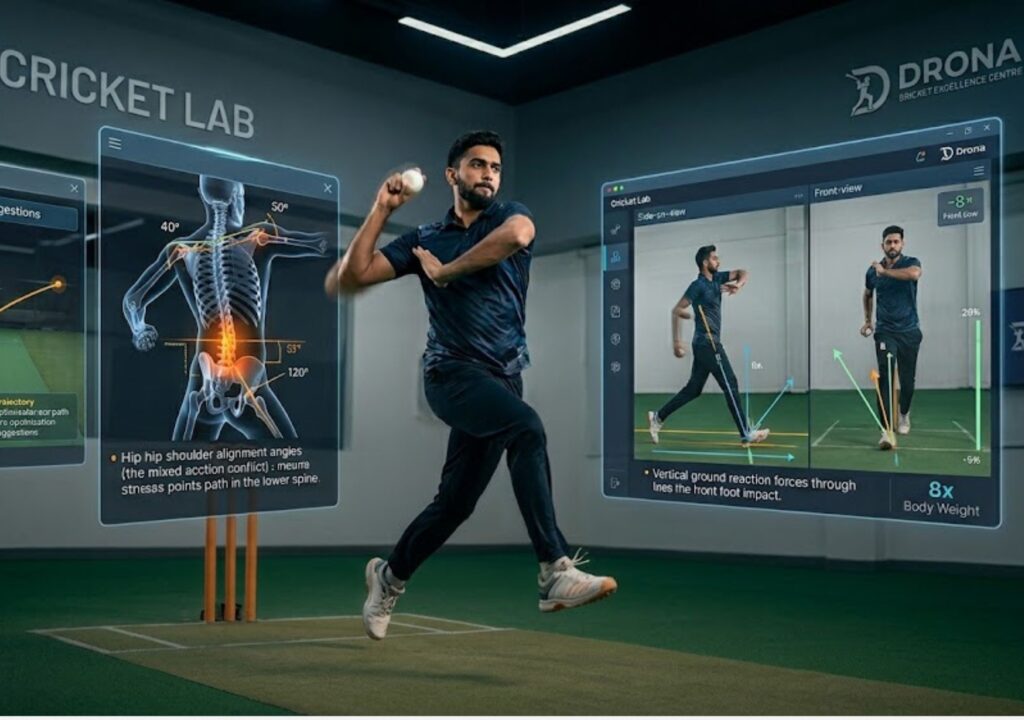
The most feared injury among young fast bowlers is the lumbar stress fracture, a micro-fracture in the pars interarticularis of the lower spine. This injury almost exclusively stems from a fundamental mechanical flaw known as a “mixed action.” A safe bowling action is typically either strictly side-on or strictly front-on, meaning the hips and the shoulders are aligned in the same direction at the point of back-foot contact. A mixed action occurs when the lower body is facing one direction while the upper body counter-rotates to face another. When the bowler drives through the crease with a mixed action, their spine is forced into a dangerous combination of hyperextension, lateral flexion, and violent rotation. Over time, this repetitive torque creates micro-traumas in the bone tissue, eventually cracking the vertebra and sidelining the athlete for six to twelve months.
The naked eye of even the most experienced coach is simply not fast enough to catch these micro-misalignments in real-time. The transition from back-foot contact to ball release occurs in milliseconds. This is precisely why the Drona Cricket Excellence Centre heavily relies on our advanced “Cricket Lab” technology. By utilizing high-speed, multi-angle video analysis, our coaching staff can freeze time and dissect a fast bowler’s action frame by frame. We map out the exact angles of the hips and shoulders during the gather, measure the stability of the front knee brace upon impact, and track the lateral deviation of the run-up. This data-driven approach removes all guesswork from our coaching methodology, allowing us to scientifically pinpoint the exact origin of biomechanical stress.
Identifying the mechanical flaw is only the first step; correcting it before an injury occurs is where true athletic development takes place. Armed with precise video data, our technical coaches and strength and conditioning experts collaborate to rebuild the bowler’s mechanics safely. Rather than relying on verbal cues that a young athlete might struggle to visualize, we show them their own footage alongside elite mechanical benchmarks. We then prescribe highly specific corrective drills often starting with walking paces and localized core-stability exercises to realign their momentum, ensuring their kinetic energy flows linearly toward the target rather than destructively through their lower back.
At Drona, we believe that extreme pace should never come at the cost of a player’s physical longevity. Fast bowling is a weapon, and like any high-performance weapon, it requires precision engineering and constant calibration. If you or your child is an aspiring fast bowler looking to increase pace safely or correct an action that is causing pain, do not wait for a structural breakdown.
– Mr. Dnyaneshwar Jagdale (Head Coach at Drona)