
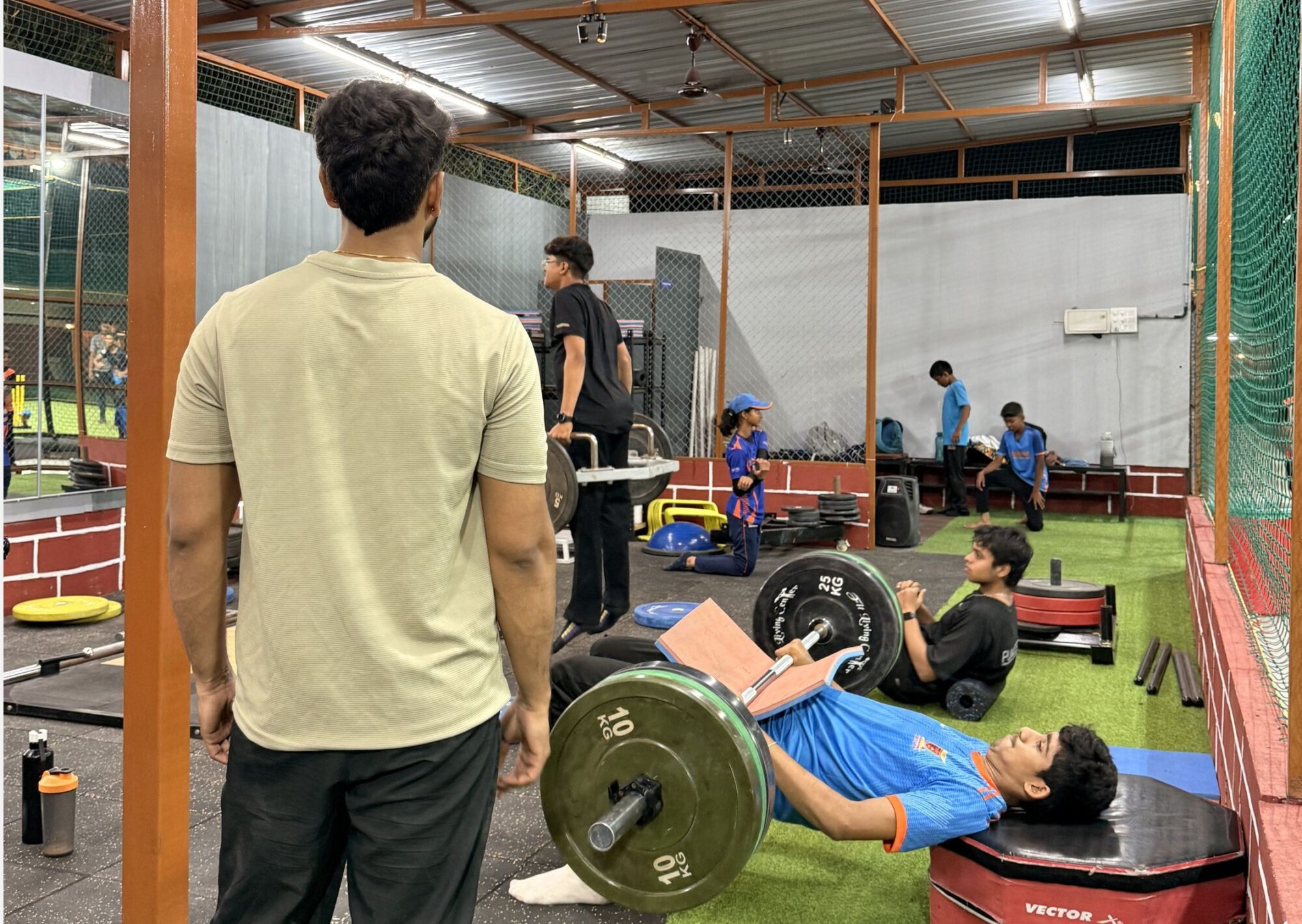
Many cricketers believe that stepping into a gym and “lifting heavy” is the only way to get fit. However, the world of modern cricket demanding 365 days of high-performance requires a much more precise and evolved approach. While basic gym workouts build visible muscle and a base layer of strength, cricket-specific Strength & Conditioning (S&C) is engineered to build responsive athletes capable of executing skills powerfully and repeatedly, with a focus on injury prevention.
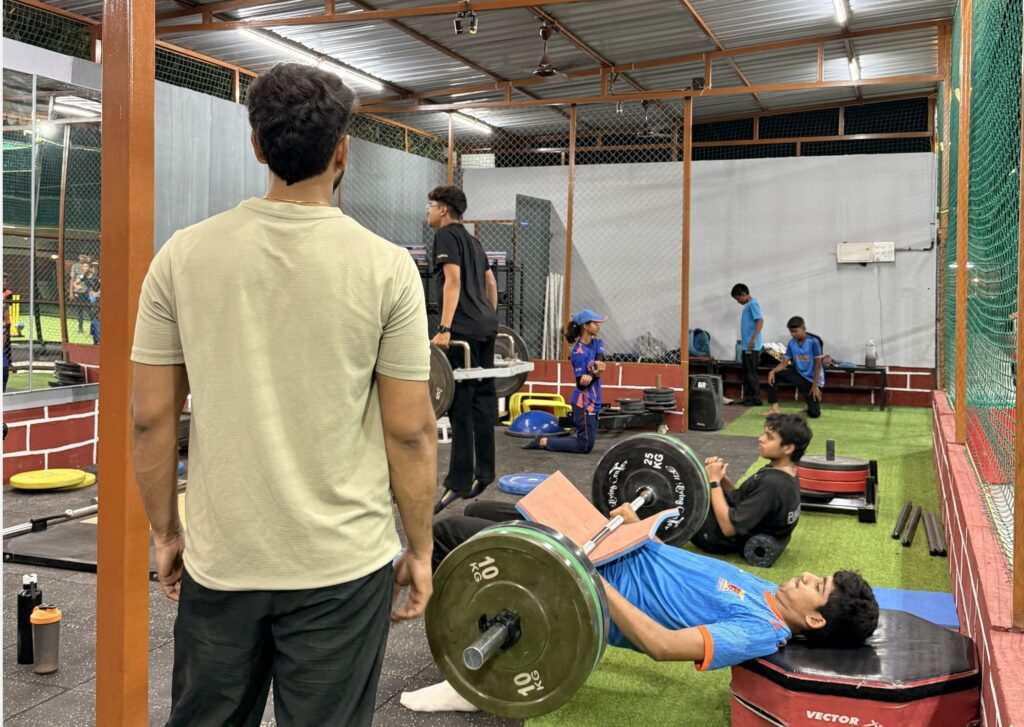
This article breaks down why “lifting weights” is just the start, and what a holistic, cricket-specific fitness ecosystem actually looks like.
1. The Core Differentiator: General vs. Kinetic Authority
Traditional Gym Fitness (General): The primary goals are often hypertrophy (muscle growth) and general strength increase. Think isolated, single-plane movements like the bench press, bicep curls, or generic leg presses. While these exercises make an athlete stronger, that strength is often generalized and static. It can build big, powerful muscles, but it doesn’t always teach those muscles to work in harmony for a sport as dynamic as cricket.
Drona Cricket S&C (Kinetic Authority): We define cricket fitness by your kinetic authority, your ability to transfer force efficiently through the kinetic chain, across multiple planes of motion. When a bowler releases a ball at 140 kph, or a batter lofts a six over long-on, the power does not come from single muscles. It is an explosive chain reaction starting from the ground, surging through the legs, rotating through the core, and releasing through the arm or bat. Our routine focuses on functional, multi-joint movements that replicate and enhance these exact sequences.
2. The Four Pillars of Cricket Specific S&C
To engineer a complete athlete, our S&C curriculum moves beyond general lifting into four specialized pillars that target the unique physical demands of the game:
Pillar 1: Rotational Core & Anti-Rotation Mastery
Cricket is, fundamentally, a rotational sport. Batting requires massive, explosive torso rotation for shot power, while bowling involves violent coil and uncoil mechanics. However, “core strength” at Drona is not defined by sit-ups. We focus on two critical, overlooked components:
- Rotational Power: Training your core to generate force dynamically (e.g., medicine ball throws, cable core rotations, landmine rotations). This is the engine of your shot power and bowling pace.
- Anti-Rotation Stability: Equally important is the core’s ability to resist rotation, stabilizing the spine against forces that want to violently torque it (e.g., Pallof press, dead bugs, farmer’s carry). This protects a batter’s spine during the follow-through and builds vital torso stiffness for fielders throwing with power.
Pillar 2: The Rate of Force Development (Explosive Power)
In cricket, having general strength is not enough; you must be able to deploy that strength instantly. This is called the Rate of Force Development (RFD). A fast bowler has a tiny fraction of a second in the delivery stride to transfer force to the ball. A batter needs split-second explosiveness to drive a quick ball.
Traditional gym work is often too slow to enhance this quality. At Drona, we use explosive, full-body Olympic lifting variations (e.g., hang cleans, snatches), full-body plyometrics (e.g., box jumps, jump squats), and reactive jump drills to teach the nervous system to activate muscles quickly, translating raw strength into on-field explosiveness.
Pillar 3: Injury-Prevention Mobility & Kinetic Longevity
A significant amount of generic lifting is performed to create hypertrophy, which can sometimes lead to decreased joint mobility if not managed. This is dangerous in cricket. High-performance actions like a bowling delivery stride, dynamic fielding stops, or a wide cover drive crouch require a massive, stable range of motion.
Our S&C work integrates mobility as a foundational requirement, not an afterthought. We focus on:
- Hip Mobility: For stable cover drives, efficient running between wickets, and absorbing ground reaction forces during bowling.
- Thoracic Spine (T-Spine) Mobility: Critical for allowing necessary rotation in both batting and bowling without torque transferring to the lower back, directly preventing stress fractures.
- Shoulder Stability: Vital for throwing velocity and protecting the joint from the extreme repetitive strain of bowling or high-volume fielding.
Pillar 4: Cardiovascular Resilience & Repeated Sprint Ability
Finally, a cricketer is not a sprinter or a marathon runner; they are an intermittent resilience athlete. They must survive a 5-day Test match or a grueling T20 afternoon of high-intensity intermittent bursts of work sprinting for a ball, recovering between overs, batting for an extended innings while maintaining mental focus.
Traditional steady-state cardio (like 5km runs) is often too slow. We prioritize Repeated Sprint Ability (RSA) and interval conditioning, mimicking the actual work-to-rest ratios of the game to ensure an athlete can execute explosive stops and starts at their maximum capacity, even in the 90th minute.
Your Next Step: The skill evaluation at Drona Cricket
The facilities are set. The coaches are ready. The only thing missing is your commitment to a truly engineered, holistic approach to athletic development. If you are serious about transforming into an elite, responsive athlete, we invite you to take the first step and join our fitness program at Drona.
– Atharva Sir (Fitness Coach at Drona)